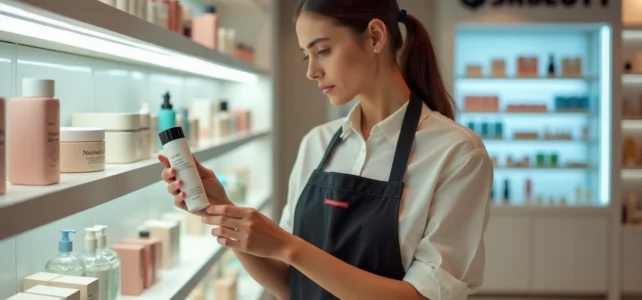
Nocibé is a retail brand, not a cosmetics manufacturer. This distinction radically changes the way its policy on animal testing is analyzed. The brand sells products from dozens of different groups, with variable practices depending on the markets, ingredient suppliers, and local regulations.
Asking about the relationship between Nocibé and animal testing requires untangling what falls under European law, what falls under the voluntary commitments of the brand, and what escapes any visible control.
Distributor or manufacturer: a confusion that skews the cruelty-free debate
When searching for whether a brand tests on animals, one instinctively thinks of a laboratory developing formulas. Nocibé is not in this situation. The brand purchases and resells cosmetic products, perfumes, and treatments manufactured by third parties.
Its private labels (ranges sold under the Nocibé name) are formulated by subcontractors. The responsibility for testing then falls to the manufacturer or the contractor who brings the product to the European market. Nocibé does not have a testing laboratory under its name, but this is not enough to guarantee the complete absence of animal testing in the production chain.
The real issue lies upstream: the ingredients. A pigment, a preservative, or a surfactant may have been tested on animals under the REACH chemical regulation, even if it ends up in a cosmetic product sold in France.
This is the most documented gray area by animal protection associations, and it concerns all beauty brands, including Nocibé. To delve deeper into the question of Nocibé testing on animals, a comprehensive analysis details the brand’s actual commitments.
European regulation on cosmetics and its concrete limits
The European regulation CE 1223/2009 prohibits the marketing of finished cosmetic products tested on animals. The ban also covers ingredients developed exclusively for cosmetic use. Any brand selling cosmetics in France, including Nocibé, operates under this framework.
The limit appears as soon as an ingredient has a dual use. A chemical compound used both in a cosmetic and in an industrial product may be subject to animal testing under REACH, the European regulation on chemical substances. The ban on animal testing does not cover dual-use ingredients when testing is required by chemical regulation.
In May 2023, the United Kingdom announced a ban on animal testing for substances used exclusively as cosmetic ingredients, aligning its policy with that of the European Union. This development reduces some of the indirect risks associated with export markets but does not resolve the issue of ingredients shared between industries.
What this changes for products sold at Nocibé
A facial treatment sold in the brand’s aisles may contain a UV filter whose safety has been evaluated through animal testing under REACH. The finished product complies with European law on cosmetics, but the manufacturing chain is not free from animal testing.
The available data do not allow us to conclude that Nocibé systematically audits its suppliers on this specific point. The brand does not publish a detailed list of its subcontractors or their testing practices.
Cruelty-free labels and certification: what Nocibé does not claim
Several independent labels certify that a brand does not test on animals and does not commission third parties to do so. The most recognized are Leaping Bunny (issued by Cruelty Free International) and the PETA label. These certifications involve audits of the supply chain, including ingredient suppliers.
Nocibé does not hold any independent cruelty-free certification covering its entire range. Some brands sold at the store have their own certification (for example, brands listed as Leaping Bunny), but this does not extend to the entire catalog.
To identify the products that are truly certified on the shelves, it is necessary to check brand by brand. Here are the criteria to examine for each product or brand:
- Presence of the Leaping Bunny logo or PETA cruelty-free logo on the packaging, not just on the brand’s website
- Absence of sales in mainland China, where pre-market animal testing remained the norm for imported cosmetics (recent regulatory changes have relaxed this requirement for certain categories, without completely eliminating it)
- Written commitment from the manufacturer covering ingredient suppliers, not just the finished product
- Verification that the parent brand (the owning group) does not have a different policy from the subsidiary
The brands on the shelves: a heterogeneous catalog on animal issues
Nocibé distributes brands belonging to large international cosmetics groups. Some of these groups have long been present in the Chinese market under conditions that involved regulatory animal testing. Nocibé’s catalog mixes brands with very different policies on this subject.
A retail brand does not have the same leeway as an engaged manufacturer. It can choose to prioritize certified brands, but its business model relies on the diversity of the offer: perfumes from large groups, treatments from independent brands, private ranges.
Field feedback varies on this point. Some consumers report that in-store advisors do not have reliable information on the cruelty-free status of the referenced brands. The brand does not offer a “not tested on animals” filter on its website, unlike other retailers that have integrated this criterion into their product search engine.
Verify yourself rather than trust the brand
The most reliable approach remains to consult the databases of certification organizations. PETA publishes a regularly updated list of certified brands. Cruelty Free International maintains a directory of companies holding the Leaping Bunny.
Cross-referencing these lists with the Nocibé catalog allows for the identification of products whose status is verified by a third party. Relying solely on “not tested on animals” claims on the packaging is not enough, as this claim is not governed by any harmonized legal definition in Europe.
Nocibé’s policy on animal testing primarily reflects its nature as a distributor. The brand complies with the European regulatory framework that applies to all cosmetics sold in France. Beyond this legal foundation, the lack of independent certification and the lack of transparency regarding suppliers’ practices leave a significant part of the question unanswered with documented evidence.