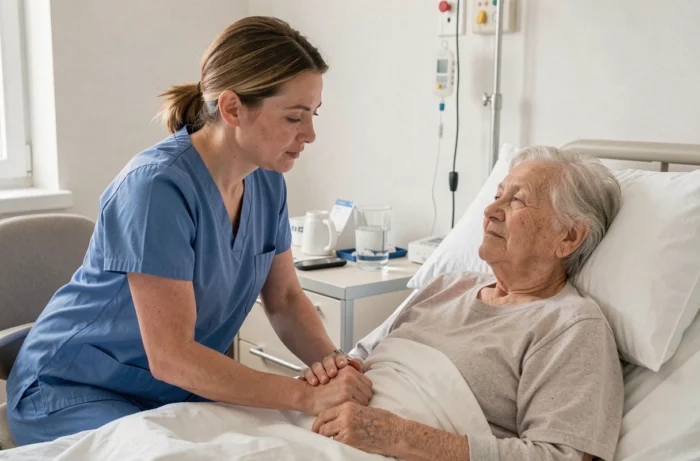
The 14 fundamental needs of Virginia Henderson still structure nursing care in France today. This model is based on a precise reading grid: identifying what a person can or can no longer accomplish alone, and then intervening accordingly.
Understanding how these needs interconnect, and especially what distinguishes them from other assessment tools, helps avoid several common confusions in training and practice.
Scoring grid for the 14 fundamental needs: evaluation levels
Each need can be evaluated according to four levels in the current educational grid, from satisfied need to severely altered need. Henderson herself did not set a standardized scale, but practice in IFSI and IFAS has adopted this gradation to facilitate clinical observation.
| Fundamental Need | Satisfied | Altered | Very Altered | Severely Altered |
|---|---|---|---|---|
| Breathing | Without discomfort | Dyspnea | Technical assistance (aerosol) | Assisted ventilation |
| Drinking and Eating | Eats alone | Setup, stimulation | Partial assistance or supervision | Total assistance (feeding tube) |
| Elimination | Continence | Assistance (toilet with help, urinal) | Day or night incontinence | Day and night incontinence |
| Mobility | Moves alone | Walker or one person | Assistance from two people | Bedridden permanently |
| Sleeping and Resting | Sleeps naturally | Sleeps with help (medication) | Frequent awakenings | Frequent insomnia |
| Dressing and Undressing | Dresses alone | Advice or supervision | Partial assistance | Total assistance |
| Maintaining Body Temperature | Adapts clothing | Requests protection | Unable to adapt clothing | No reaction |
| Being Clean, Protecting Skin | Washes alone | Partial assistance | Assistance for complete hygiene | Total dependence |
| Avoiding Dangers | Clear-minded, autonomous | Light supervision | Continuous supervision | Restraint or isolation |
| Communicating | Expresses clearly | Occasional difficulties | Technical assistance (hearing aid) | Absence of communication |
| Practicing Religion, Acting According to Values | Practices freely | Requests occasional help | Cannot practice without help | Unable to express values |
| Engaging in Activities for Self-Realization | Autonomous activities | Stimulation needed | Assistance for any activity | No activity possible |
| Recreation, Entertainment | Autonomous leisure | Help with organization | Passive participation | No leisure |
| Learning | Learns alone | Needs repetition | Active help to understand | Inability to learn |
This table allows for a quick visualization of a patient’s degree of dependence in each dimension. The information compiled here comes from the grid disseminated by Famidac and IFSI educational resources. To delve deeper into each need with detailed definitions, the entire content is available on the dedicated page on Maxi Bottin with a breakdown by category.

Interdependence of Needs: What the Henderson Model Changes Compared to Maslow
The most common confusion in training is to impose Maslow’s pyramid onto Henderson’s 14 needs. The needs of Henderson do not form a hierarchy to be climbed in a fixed order. They are interdependent: a disturbance in sleep can affect the ability to communicate, which in turn influences the need for self-realization.
Maslow proposes five hierarchical levels (physiological, safety, belonging, esteem, achievement) where each level must be generally satisfied before moving on to the next. Henderson, on the other hand, evaluates the 14 needs simultaneously. A patient in palliative care may have a severely altered need to breathe while also expressing a spiritual or relational need that is equally priority for the caregiver.
This difference has a direct consequence on the care approach. With Maslow, a caregiver might consider psychosocial needs secondary as long as physiological needs are not stabilized. The Henderson model requires evaluating all needs from the initial care, without waiting for the resolution of one need to examine the others.
Sources of Dependence According to Henderson: Strength, Will, Knowledge
Henderson identifies three possible causes when a need is not satisfied. This causal grid directly guides the type of nursing intervention.
- Lack of Strength: the patient does not have the physical ability to perform the action (getting up, washing, eating). Nursing assistance compensates with motor or technical assistance, such as a lift or furniture adaptation.
- Lack of Will: the person has the physical ability but lacks motivation or psychological drive. This is common in situations of depression, grief, or loss of bearings. The intervention then aims at stimulation and relational support.
- Lack of Knowledge: the patient does not know how to satisfy their need, for example, a diabetic who does not master dietary adjustments. Therapeutic education becomes the main tool.
This distinction is fundamental: two patients rated at the same level of dependence on a need may require radically different interventions. One may need physical assistance, while the other requires an educational program. Confusing the two leads to ineffective care plans.
Difference Between the Henderson Model and Autonomy Assessment Tools
Another frequent point of confusion concerns the status of the model. The grid of 14 needs is not a formal autonomy scale comparable to the AGGIR grid used for APA allocation, nor to ADL (activities of daily living) or IADL (instrumental activities of daily living) scales.
AGGIR measures a global dependence score, classifying the person into GIR 1 to 6 to determine a level of assistance. The ADL and IADL scales quantify specific functional abilities (eating, making phone calls, managing finances). The Henderson model, however, offers a conceptual framework for organizing clinical observation. It does not produce a weighted score or administrative ranking.
In practice, caregivers use Henderson to structure data collection and clinical reasoning, then tools like AGGIR or the BSI (nursing care assessment) to formalize and communicate the evaluation. The two approaches complement each other without substituting for one another.

The Virginia Henderson model remains a reasoning tool, not a form to be filled out mechanically. Its value lies in the distinction between what the patient cannot do, does not want to do, and does not know how to do. It is this causal analysis that transforms a checklist into a personalized care plan.