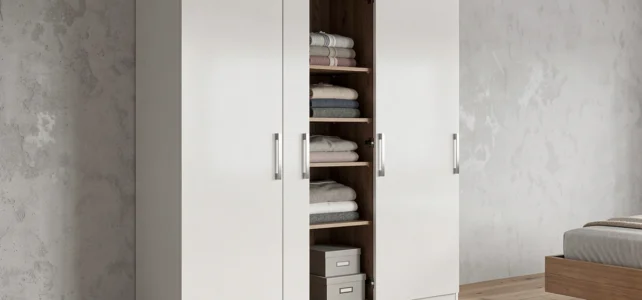
An AC3M wardrobe stands out due to its modular design and compatibility with the most constrained interior configurations. Choosing the right model requires mastering a few technical parameters often overlooked in consumer guides: usable depth, type of load-bearing structure, and internal organization by zones.
Usable Depth and Load-Bearing Structure of an AC3M Wardrobe
The depth stated on a product sheet almost never corresponds to the actually usable depth. Between the thickness of the back panel, the setback imposed by the hinges, and the space taken up by the slides, several centimeters can easily be lost. For a standard hanger to hang freely without rubbing against the closed door, the interior depth must reach at least 55 cm.
On AC3M wardrobes, the structure is based on melamine-faced particle boards or, in higher ranges, on MDF covered with veneer. The choice of material directly affects the rigidity of the shelves under load and the durability of the fittings over time. A panel that is too thin (less than 18 mm thick) will bend as soon as heavy laundry is piled on it.
We recommend systematically checking the type of hardware supplied. Metal eccentric fittings and beech dowels provide a more stable assembly than self-tapping screws in low-quality panels. This detail, rarely mentioned, conditions the longevity of the furniture.
To browse the available references, an AC3M wardrobe at J3M allows for direct comparison of the depths and finishes offered for each configuration.
Type of Opening Based on Room Configuration
The choice between hinged doors and sliding doors depends on the available clearance in front of the furniture, not on aesthetic preference. A hinged door requires a free floor space equivalent to its width. In a narrow bedroom or a fitted hallway, this clearance is often lacking.
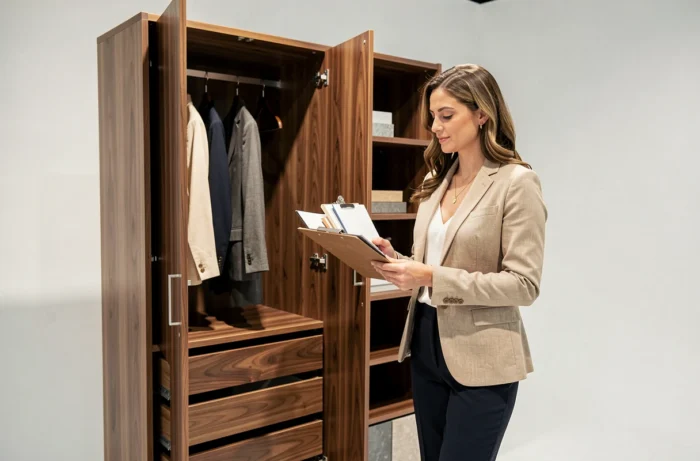
Sliding doors solve this problem, but with a rarely mentioned drawback: you can only access half of the contents at a time. For a two-door wardrobe, this means that one side is always hidden. AC3M models with three rails mitigate this limitation by allowing a wider offset of the panels.
In rooms with sloped ceilings or under eaves, neither the hinged nor the standard sliding door works properly. In this case, it is necessary to consider folding doors or a retractable front system, compatible with certain AC3M configurations designed for reduced heights.
Wall Fixing and Anti-Tipping Safety
A tall wardrobe (over 180 cm) placed on an uneven floor or floating floor poses a tipping risk. Securing the furniture to the wall with a metal bracket is imperative in a child’s room or a family home. Most AC3M wardrobes include a rear drilling intended for this fixation, but the wall screws suitable for the type of partition (drywall, brick, concrete) must be provided separately.
Modular Interior Layout of a Modern Wardrobe
The classic mistake is to buy a wardrobe for its gross volume without considering the internal distribution. A large empty box quickly becomes a chaotic space where laundry piles up.
We observe that the most functional layouts are based on a division into three vertical zones:
- A high zone for seasonal storage (duvets, suitcases, off-season clothing), accessible with a step stool
- A middle zone at eye level, dedicated to everyday hanging clothes, with a rod positioned between 140 and 170 cm from the floor
- A low zone reserved for drawers or sliding baskets for folded laundry, accessories, and shoes
The modularity of the shelves changes everything. Adjustable shelves on brackets allow for adapting the height of each compartment over the seasons or with a wardrobe change. Fixed peg systems, which are less expensive, lock the organization in place once assembled.
Internal Accessories to Prioritize
A drawer with compartments for belts and ties, a pull-out rod for hangers in reduced depth, a sliding trouser rack: these accessories transform a generic wardrobe into a piece of furniture truly suited for daily use. In the AC3M ranges, these elements can be ordered separately to create a custom interior without resorting to built-in furniture.
Design and Finishes for a Contemporary Interior
The design of a modern wardrobe revolves around three parameters: the front finish, the treatment of handles, and the visual integration into the room. Current trends favor smooth facades without moldings, with neutral tones (matte white, light oak, anthracite gray) that adapt well to a bedroom, office, or entryway.
Recessed handles or push-to-open systems eliminate protrusions and give the furniture a sleek appearance. This choice is not only aesthetic: in a narrow hallway, a protruding handle can snag clothing and obstruct movement.
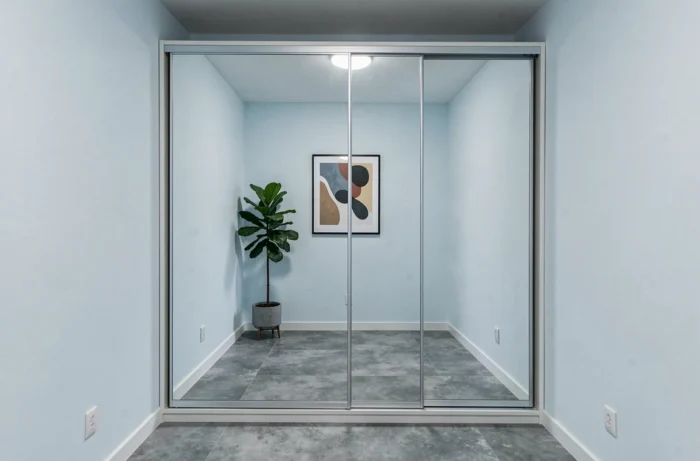
AC3M wardrobes also offer mirror front options, useful for visually enlarging a small space. A mirror integrated into a wardrobe door replaces a wall mirror and frees up floor space or adjacent wall space.
Standalone Wardrobe or Built-In Closet: What the Choice Implies
A wardrobe remains a standalone piece of furniture, movable and resalable. A built-in closet offers maximum space optimization, but it is fixed to the dwelling. For a tenant or a homeowner considering moving, a standalone wardrobe retains a decisive advantage in terms of flexibility.
Custom-built options cost significantly more than a well-configured modular wardrobe. In most situations, a properly sized AC3M wardrobe equipped with suitable accessories fulfills the same functions as a built-in dressing room, without the constraints of permanent installation.
The final criterion remains the coherence between the furniture and the room. Measuring the available space, checking the clearance of the doors, controlling the usable depth, and choosing an internal layout suited to actual habits: these four steps are sufficient to avoid the most common mistakes.