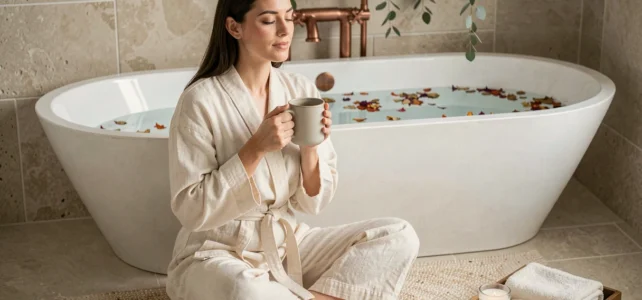
A wellness space at home does not require an entire room or a significant budget. A corner of a bedroom, a nook under a staircase, or a small part of the living room is sufficient, provided you master three parameters: sensory isolation from the rest of the home, air quality, and the type of light received. These three aspects, often treated separately, work together to transform a simple corner into an effective relaxation zone.
Air Quality and Thermal Comfort in a Relaxation Corner
Most wellness design guides focus on decoration. Furniture and colors matter, but air quality determines the feeling of relaxation long before the choice of a cushion. Stale air or a room that is too hot negates the desired effect, even in an aesthetically pleasing setting.
For an indoor space dedicated to relaxation, regular ventilation remains the simplest gesture. Opening the window for ten minutes before each meditation or reading session refreshes the air effortlessly. In rooms without direct openings, an air purifier equipped with a HEPA filter captures fine particles and limits allergens.
Thermal comfort plays a parallel role. A temperature slightly below the average of the home promotes muscle relaxation. A connected thermostat allows you to program a temperature suitable for relaxation times, without altering the settings of other rooms. It’s also an opportunity to discover practices like singing bowl relaxation on C Ma Déco, which fits perfectly into a space where air and temperature are already controlled.
Adaptive Lighting for a Relaxation Space at Home
Soft light is a recurring piece of advice, but it often lacks precision: fixed lighting is not suitable for all times of the day. A morning yoga session requires bright, cool light to stimulate awakening. An evening reading calls for warm, dim light to prepare for sleep.
Controllable lighting systems meet this need. They allow you to vary both the intensity and the color temperature, expressed in kelvins. Light around 5,000 K replicates daylight, while light at 2,700 K resembles that of a candle.
Natural Light and Room Layout
Before investing in a connected system, the orientation of the room deserves special attention. A relaxation corner placed near an east-facing window receives morning light, ideal for meditation. A west-facing location captures evening light, more conducive to reading.
Linens or sheer curtains can filter natural light without blocking it. The goal is to maintain a connection with the outside while controlling glare. A light wood floor or a wall in neutral tones amplifies ambient brightness without creating harsh reflections.
Micro-Wellness Space: Zoning and Suitable Furniture
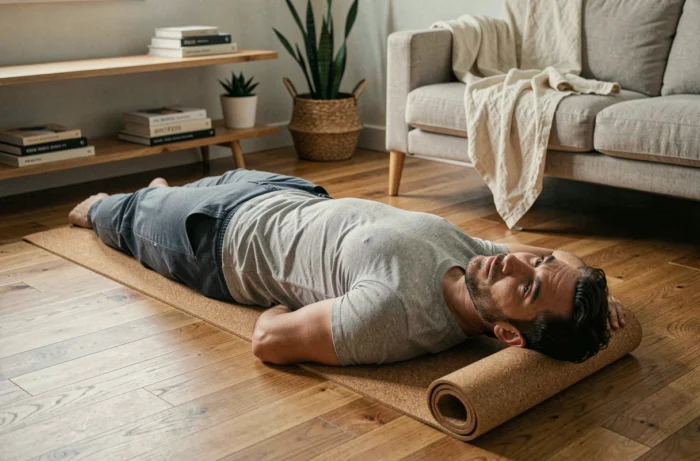
The current trend leans towards highly targeted micro-wellness spaces rather than an entire dedicated room. A reading chair in a bedroom corner, a meditation mat near a living room window, a low stool in the bathroom: each configuration works if the zoning is clear.
Zoning involves visually delineating the relaxation corner from the rest of the room. Three simple methods:
- A thick rug of a different shape from the main flooring creates an immediate visual boundary, even in a small living room
- A screen made of natural materials (rattan, bamboo, fabric) partially isolates the space without construction or loss of light
- A change in level, even minimal (a few centimeters wooden platform), marks the transition between the living area and the relaxation zone
Low Furniture and Clear Circulation
Low furniture enhances the feeling of space and naturally encourages slowing down. A pouf, a floor cushion, or a chair close to the ground is more suitable for a relaxation corner than a high chair. The passage around the furniture must remain clear to prevent the space from becoming a cluttered corner that is eventually ignored.
Multifunctional furniture extends the longevity of the design. A chest that serves both as storage and seating, a low shelf that holds candles and books: each element fulfills at least two functions. This approach limits the accumulation of objects, the main cause of abandoning a home wellness corner.
Sensory Atmosphere: Natural Materials and Sounds for Relaxation
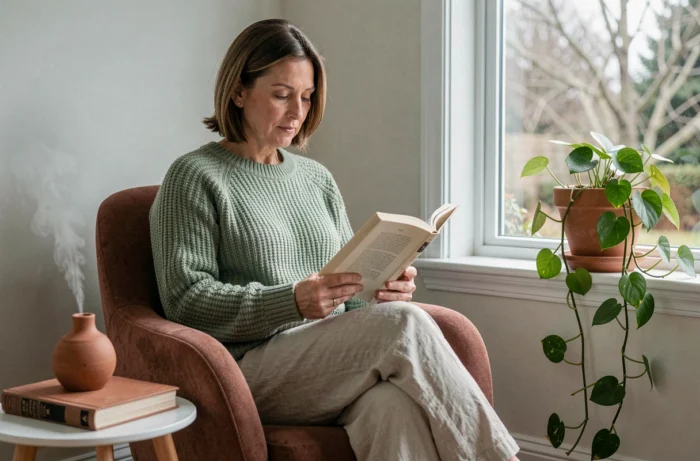
The ambiance of a wellness space relies on what the senses perceive beyond sight. Touch comes into play as soon as one sits down: a raw wood surface underfoot, a wool blanket, or a linen cushion produce a tactile sensation that synthetic materials cannot replicate.
Natural materials also have an acoustic advantage. Wood, cork, and thick textiles absorb some ambient sounds. In an apartment where noise from neighbors or the street filters in, this passive absorption improves the sound comfort of the relaxation corner without complex installation.
Plants and Living Elements in the Indoor Space
Indoor plants contribute to the visual ambiance and, to a lesser extent, to air quality. Broad-leaved varieties like ficus or spathiphyllum adapt well to low-light spaces. Their presence introduces a living element that breaks with the inert surfaces of furniture.
The addition of discreet sounds enhances the atmosphere. A small indoor fountain produces a continuous sound of water that masks distracting noises. A singing bowl, used at the beginning or end of a meditation session, marks a clear sound transition between daily life and relaxation time.
Designing a home wellness space relies less on the available area than on the coherence between air, light, zoning, and materials. A well-thought-out two-square-meter corner on these four axes provides more comfort than a large, poorly ventilated room cluttered with decorative furniture.