
You are a civil servant and your retirement is approaching. Before leaving your position, an administrative step is necessary: drafting and sending a formal letter to your employer. This retirement departure letter in the public service follows specific rules, different from those in the private sector. If poorly written or sent too late, it can delay the processing of your pension.
Digital request via ENSAP: what it changes for your letter
Since February 1, 2025, the retirement request made through the ENSAP portal simultaneously serves as a request for removal from the payroll with the employer. In practice, your letter no longer functions as an isolated correspondence.
It must be aligned with the digital process. If you are a state civil servant, your letter should explicitly mention that you have initiated (or will initiate) your request on ENSAP, specifying the desired removal date.
For agents in local or hospital public service, the procedure remains different: the letter addressed to the local authority or the director of the establishment retains its central role. It is the employer who then forwards the file to the CNRACL. If you are looking for a model retirement departure letter for public service suitable for your situation as a local or hospital agent, make sure it includes the specific mentions required by your pension fund.

Sending deadline and registered letter: mistakes that delay your pension
You must send your request at least six months before the desired departure date. This deadline is not just a recommendation. It conditions the processing of your file by the CNRACL or the State Retirement Service.
Why six months? Your employer must gather the supporting documents, verify your service records, and then submit the complete file to the pension fund at least three months before your departure. If your letter arrives late, the entire process is delayed.
- Send your letter by registered mail with acknowledgment of receipt. This is the only proof of the sending date that can be opposed in case of dispute.
- Keep a copy of the letter and the acknowledgment receipt in your personal records.
- If you hand the letter in person, request a signed and dated receipt from your HR department.
A letter sent five months before departure instead of six may suffice in certain local authorities. Check with your departmental management center, as practices vary.
Content of the retirement departure letter: mentions not to forget
The writing should remain sober and factual. No need for literature: your employer expects precise information to compile your file.
Elements to include in your letter
- Your name, first name, postal address, email address, and phone number.
- The contact details of your employer (mayor, president of the local authority, or director of the hospital establishment).
- The subject of the letter: “Request for retirement departure”.
- The explicit mention of your wish to cease your functions to claim your CNRACL pension rights (or the SRE for state public service).
- The specific date on which you wish to cease your activity.
- If applicable, the request for the liquidation of your additional RAFP pension and the desired date for its payment.
Standard wording for the body of the letter
One sentence is enough to express your intention: “I wish to inform you of my desire to cease my functions to claim my CNRACL pension rights as of [date].” Add, if applicable: “I wish for my additional RAFP pension to be liquidated as of [date].”
End with a classic polite closing. Sign by hand if you are sending a paper letter. Avoid any ambiguous wording that could be interpreted as a mere project rather than a firm decision.
Progressive retirement in the public service: adapting your letter to this option
Since the decrees of July 2025, progressive retirement is open to sedentary civil servants starting at 60 years old, subject to 150 quarters and part-time work between 50% and 90%. If you are considering this option instead of a definitive departure, your letter must be drafted differently.
You are not requesting removal from the payroll but permission to switch to part-time work as part of a progressive retirement. The letter then mentions the desired part-time percentage and the effective date.
One point to remember: the employer must justify any refusal of part-time work in this context. Formulating your request in writing, by registered mail, creates a useful record if the response is delayed or if it is negative without justification.
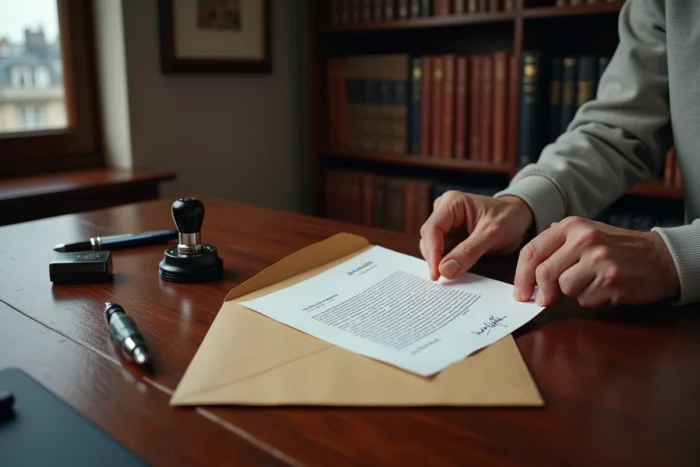
Checks before sending: the checklist that avoids back and forth
Before posting your letter, take a few minutes to check these often-overlooked points.
Ensure that the desired departure date complies with your legal retirement age. If you are retiring before this age (long career, disability, handicap), specify the reason in your letter.
Check that your career statement on the CNRACL website or on ENSAP is up to date. Missing quarters identified after sending the letter can delay the processing by several months. Contact your HR department or management center to report any anomalies before formalizing your request.
Finally, if you have contributed in the private sector during your career, remember to simultaneously carry out your procedures with the Retirement Insurance for the general scheme. The letter to your public employer only covers the CNRACL or SRE pension, not your rights accrued in other schemes.
A well-written letter sent on time is the first condition for your transition to retirement to proceed without administrative hiccups. The rest depends on the follow-up of your file, which you can consult directly from your personalized CNRACL or ENSAP space.