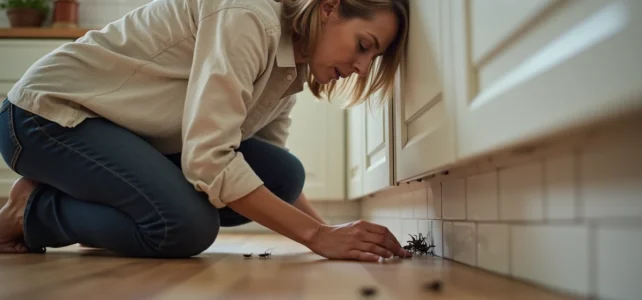
The ophone (genus Ophonus, family Carabidae) is not a pest in the regulatory sense. However, we observe massive reports every summer, almost always related to confusion with the oriental cockroach. Before spraying anything, the absolute priority remains the formal identification of the species.
Comparative morphology of ophone and cockroach: distinguishing criteria
The confusion is based on a common superficial profile: dark, flattened insect, fast, active at night. Upon close observation, the differences are unambiguous.
The ophone has rigid and fused elytra typical of beetles. It does not fly or flies very poorly. Its antennae are threadlike, inserted between the eyes and mandibles. The body often displays a bronze or copper metallic sheen under direct lighting.
The oriental cockroach, on the other hand, has soft membranous wings (even though it rarely flies), antennae longer than its body, and an oval shape without metallic sheen. A simple test: turn the insect over. The sternum of a carabid is segmented and hard, while that of a cockroach is soft and uniform.
We recommend photographing the insect against a light background with a coin for scale, then submitting the photo to an entomologist or a specialized forum before taking any action. An anti-cockroach treatment applied to ophones is unnecessary, costly, and contaminates your interior without reason.
To combat an invasion of ophones, the process always starts with this identification step, which conditions the rest of the protocol.
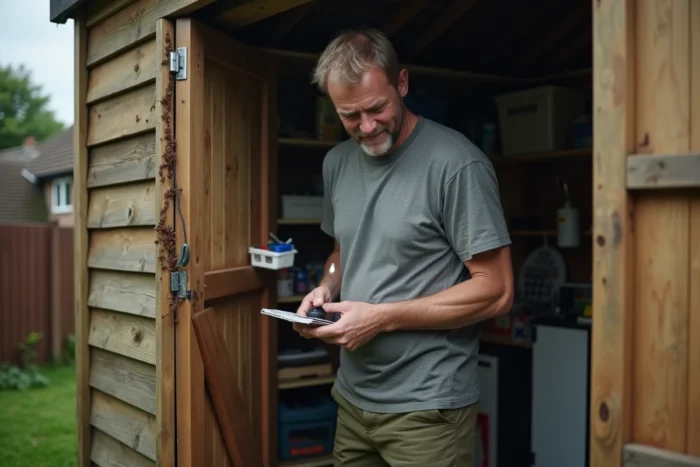
Entry points for ophones in a house: building diagnosis
The ophone is an outdoor insect, a predator of slugs, larvae, and ground seeds. It does not seek your kitchen. It is artificial light that diverts it from its natural habitat, just like a moth.
The entry points follow a predictable logic:
- Poorly sealed door thresholds, especially patio doors leading to an unlit garden or terrace
- Windows without screens left open in the evening, especially on lower floors close to vegetation
- Technical ducts, cable passages, and crawl space vents lacking fine mesh grilles
- Connected garages where the light stays on late
A quick diagnosis involves inspecting these points with a flashlight after sunset. We regularly find that the majority of ophones enter through a single access point, often a worn threshold seal of a few millimeters.
Evacuation protocol and physical barriers against ophones
The ophone does not colonize a dwelling. It finds neither suitable food nor breeding conditions. The proper response is capture and release outside, not extermination.
A glass and a sheet of paper are sufficient. For grouped intrusions (several dozen individuals in one evening, a common phenomenon in June-July during heat peaks), a handheld vacuum with discharge into the garden works without harming the insects.
Durable physical barriers
Installing 1.2 mm mesh screens on all ventilated openings in the evening resolves almost all recurring intrusions. It is the most effective and least costly long-term measure.
Complement with brush seals or automatic door bottoms on accesses leading outside. Crawl space ventilation grilles should be equipped with insect-proof mesh if not already the case.
Management of outdoor lighting
Replace cold white bulbs (UV-rich spectrum) with warm spectrum LED lights, ideally amber. Ophones, like most nocturnal beetles, are significantly less attracted to wavelengths above 580 nm. Keep light sources away from openings: a spotlight directed towards the back wall of the garden rather than towards the facade greatly reduces influx.

Insecticides against ophones: why we advise against them
No professional pest control protocol specifically targets ophones, because they are not classified as pests. Products used against cockroaches (fipronil-based gels, boric acid) have no attractive effect on a carabid that does not consume the same substrates.
Applying a surface insecticide along baseboards kills ophones on contact, but also spiders, rove beetles, and other beneficial auxiliaries present in your habitat. The benefit-risk ratio is unfavorable: you eliminate a harmless insect while exposing your pets and children to persistent chemical residues.
If, despite physical barriers and lighting management, intrusions persist at an abnormal level (daily presence of several dozen individuals for more than two weeks), we recommend calling in a diagnostician to check that it is not another species. Confusion with the golden carabid, darkling beetle, or certain species of dermestids would change the diagnosis.
Ecological role of the ophone: an auxiliary to preserve
The adult ophone consumes weed seeds and larvae of soil pests. In a garden, its presence is an indicator of soil health. Carabid populations are indeed used as bioindicators in cultivated soil ecology.
Exterminating these beetles amounts to removing a link in natural regulation. Gardens treated with surface insecticides often see a resurgence of slugs and root aphids, precisely the prey that carabids regulated.
Coexisting with the ophone requires no particular effort once access points are secured. A properly screened and warmly LED-lit dwelling no longer experiences significant intrusions, even in the height of summer.