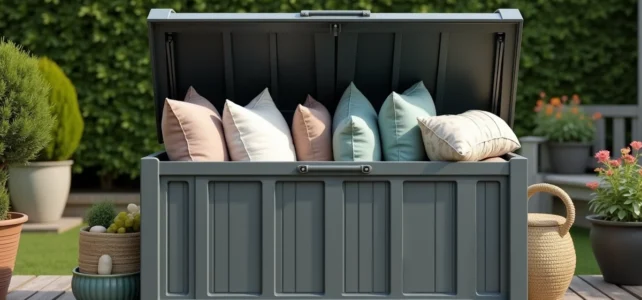
Storing garden lounge cushions, putting away a lawnmower, or hiding trash bins: the outdoor storage box serves very different functions depending on the household. The problem is that a poorly sized model or one made from an unsuitable material will end up rusting, warping, or smelling musty in less than two seasons. Before heading to the checkout, a few technical criteria deserve to be laid out.
Condensation and ventilation: the trap that material alone cannot solve
Have you ever opened a garden box after a week of rain to find damp cushions, even though the lid seemed perfectly waterproof? The problem doesn’t always come from a leak. It often arises from internal condensation.
When the warm air trapped inside the box meets the cooled walls at night, moisture settles on textiles and tools. A waterproof box without ventilation becomes a mold chamber. The models that work best combine an effective lid seal against rain and discreet openings (low side grilles or a slatted bottom) that allow a trickle of air to circulate.
Before buying, it’s useful to choose a Brico Dépôt garden box by checking if the model you have in mind offers this double protection. A box placed directly on the lawn exacerbates the phenomenon: moisture rising from the bottom accelerates the degradation of the contents. Plan for a slab, bearers, or at least a bed of gravel to elevate the base by a few centimeters.
Resin, wood, or metal: choosing the material based on the actual use of the box
The material should not be chosen for its look. It should be chosen based on what you will store, sun exposure, and how much time you are willing to dedicate to maintenance.
Resin garden box
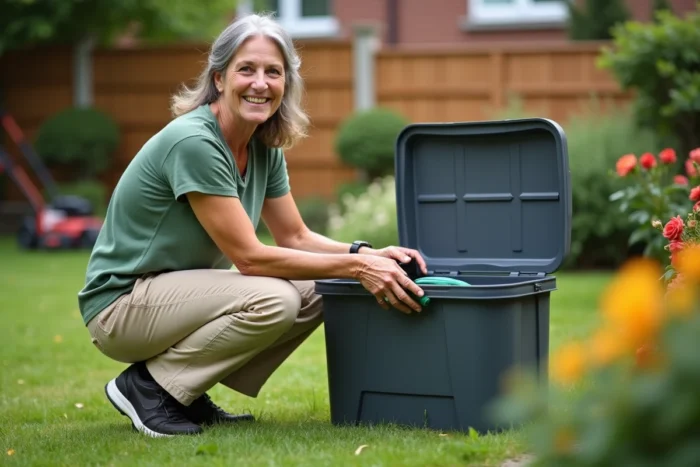
Resin (polypropylene, woven resin) dominates the market for a simple reason: it does not rust, does not rot, and can be cleaned with a water jet. It is the most suitable choice for cushions, children’s toys, or small tools. However, low-quality resin can become brittle after several summers of UV exposure. Check that the manufacturer mentions UV treatment or a warranty covering discoloration.
Wooden garden box
Wood brings a natural aesthetic that integrates well with terraces. A treated pine box withstands moisture reasonably well, but it requires a stain or saturator every two to three years. If you’re looking for storage for heavy tools, wood offers good structural robustness. Keep in mind that the weight of an empty box will be significantly higher than that of resin.
Metal garden box
Galvanized steel or aluminum is suitable for storing garden tools, bags of potting soil, or pool products. Metal handles heavy loads better than resin. The weak point: condensation is more pronounced on cold metal walls. A metal box without internal ventilation is not recommended for textiles.
Outdoor box capacity: think in terms of use, not liters
Manufacturers display volumes in liters, but this number alone doesn’t say much. Why? Because a box of the same volume can be long and flat (ideal for stacked cushions) or tall and deep (suitable for vertical equipment like a hedge trimmer or a folded parasol).
Ask yourself the question differently: what will go inside on a daily basis?
- For lounge cushions and a few toys, a medium-capacity box is more than sufficient. Favor a wide opening and a flat bottom.
- To store a lawnmower, a bicycle, or trash bins, aim for very large volumes. These boxes serve as a small shelter and often require anchoring to the ground.
- For garden tools (pruners, gloves, fertilizers), a small low box placed near the vegetable garden avoids trips back and forth to the garage.
Measure the bulkiest items before comparing interior dimensions. A folded cantilever parasol easily measures over one meter fifty: check the internal length, not just the overall volume.
Installation and securing of the garden box: mistakes to avoid
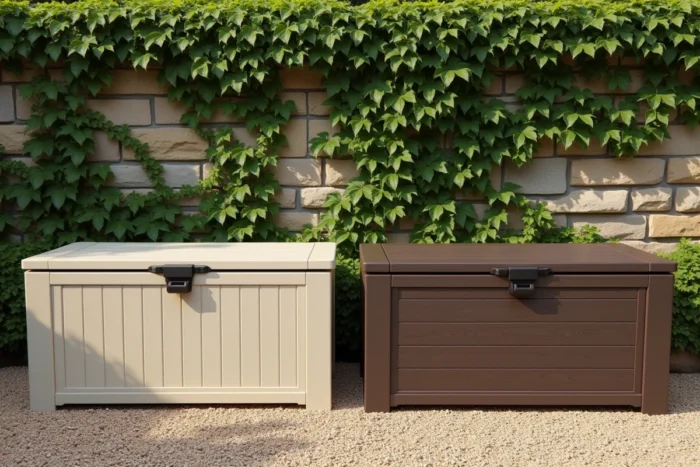
An empty garden box weighs little, especially if it’s made of resin. In strong winds, an unsecured model can tip over or move. If you live in an exposed area, plan for anchoring.
Most boxes sold at Brico Dépôt come with anchoring kits or perforations designed to screw the bottom onto a slab. Securing the box to the ground also protects against theft, a useful detail when storing power tools.
Another often overlooked point: the opening direction of the lid. A box placed against a wall with a lid that opens backward becomes unusable. Check the clearance needed above and behind the box. Models equipped with gas struts allow for a lid that stays open in the raised position, freeing both hands for loading or unloading.
Durability and warranty: what makes the difference in the long term
A cheap garden box that cracks after a year ultimately costs more than a robust model kept for eight or ten years. The manufacturer’s warranty remains the best indicator of trust. Some brands like Keter offer long warranties on their resin ranges, reflecting the material’s durability over time.
Also check the maximum load supported by the lid if you plan to use the box as an extra bench. Not all models allow this, and a lid that flexes under weight will eventually break its hinges.
Ultimately, choosing a garden box comes down to three concrete trade-offs: the material suited to your climate and your maintenance patience, the shape dictated by the items to be stored, and the quality of ventilation that will prevent unpleasant surprises upon opening. Take five minutes to measure your cushions and your terrace before consulting the catalog: it’s the most cost-effective gesture in the entire process.