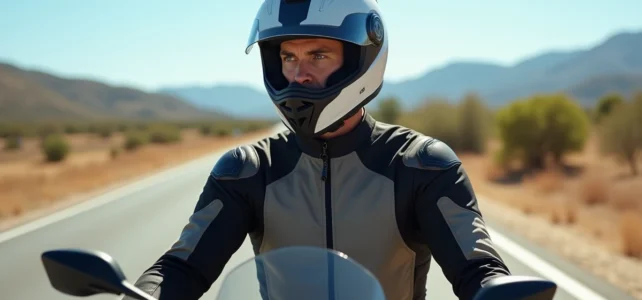
A French motorcyclist crossing the Spanish border rides under a different regulatory framework than the one he knows. Between the mandatory motorcycle equipment in Spain, those that are simply recommended, and the recent changes introduced by the DGT (General Directorate of Traffic), the differences with French regulations deserve to be measured point by point.
Mandatory motorcycle equipment: France-Spain comparison
The two countries share a common foundation but diverge on several points. The table below compares the legal obligations in force in each country for the main equipment.
| Equipment | France | Spain |
|---|---|---|
| Approved helmet | Mandatory (ECE 22.06) | Mandatory (ECE 22.05 or 22.06) |
| CE certified gloves | Mandatory | Recommended (no legal obligation) |
| High visibility vest | Mandatory (to be worn in case of emergency stop) | Mandatory (to have on board) |
| CE certified protective clothing | Recommended | Recommended |
| Boots or high-top shoes | Recommended | Recommended |
| Daytime running lights | Mandatory | Mandatory |
The most notable difference concerns gloves: mandatory in France, only recommended in Spain. A motorcyclist used to riding without gloves across the Pyrenees will not be fined for this reason. However, the high visibility vest must be accessible at all times, even if it does not need to be worn while riding.
To delve deeper into the issue of gloves and the Spanish legal framework, a detailed file specifically addresses mandatory motorcycle equipment in Spain and the nuances between obligation and recommendation.
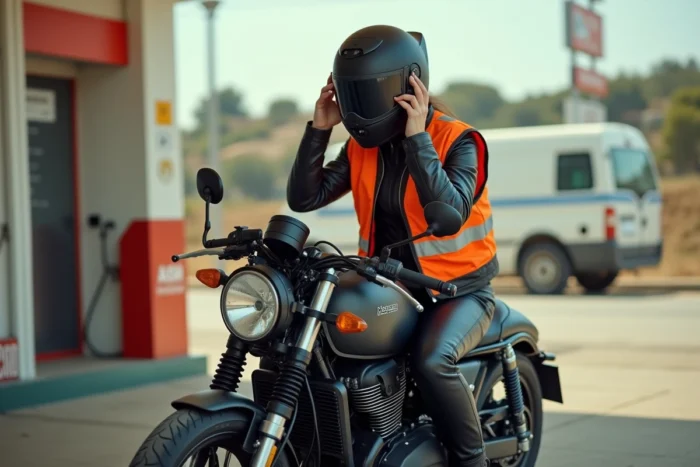
Motorcycle helmet in Spain: ECE standard and authorized types
The helmet remains the only piece of personal protective equipment whose use is penalized by a fine in Spain. The DGT requires a helmet approved according to the ECE standard (Economic Commission for Europe), which includes versions 22.05 and 22.06.
A common misconception circulates regarding the prohibition of jet helmets in Spain. No provision from the DGT prohibits this type of helmet, as long as it bears the ECE marking. An approved jet helmet remains legal, even on the highway.
What the ECE 22.06 standard concretely changes
The newer 22.06 standard introduces impact tests at various angles and better assesses protection against rotations. Helmets 22.05 remain accepted in Spain, but new models launched on the market must comply with the 22.06 standard. For a motorcyclist buying a new helmet before departing, checking the inner label is sufficient: the mention “ECE R22.06” or “ECE R22.05” will be present.
Road checks in Spain: what is verified depending on the route and the season
Regulation is one thing, its application in the field is another. Feedback from motorcyclists and reports on specialized networks paint a fairly clear picture of the checks.
Tourist routes and high season
Checks focus on tourist routes between June and September. The Pyrenean passes on the Spanish side, the Mediterranean coast, and the roads of the Balearic Islands are subject to increased scrutiny. The Guardia Civil primarily checks the helmet, high visibility vest, and vehicle documents.
In urban areas, checks target speed and alcohol levels more than the equipment worn. A motorcyclist in the city without gloves or wearing sneakers will not be stopped for this reason.
Highway and long journeys
On the highway, checks mainly focus on documents, tire condition, and lighting. The high visibility vest is rarely requested during routine checks, but its absence can be penalized in case of a stop on the emergency lane.
- Approved helmet: systematically checked, regardless of the type of road
- High visibility vest: checked mainly during an emergency stop or accident
- Gloves, boots, back protectors: never fined under the current Spanish regulations
- Daytime running lights: checked on highways and national roads
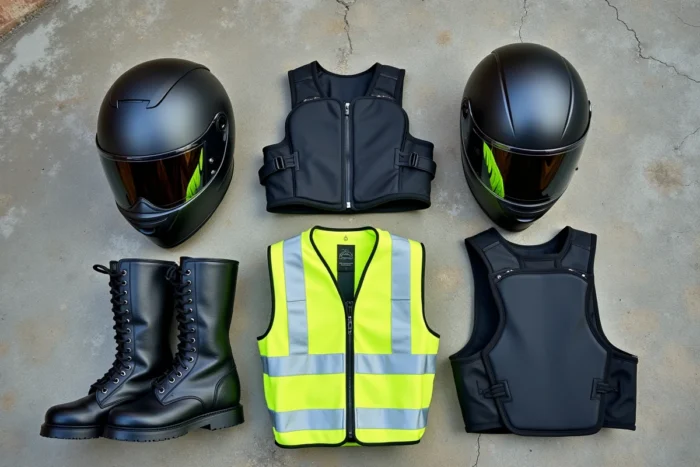
Recommended equipment and future motorcycle obligations in Spain
The DGT has expanded its scope of action in recent years, not only regarding worn equipment. Recent developments also affect traffic (use of the emergency lane, stricter blood alcohol thresholds) and suggest a gradual tightening.
CE certified protective clothing
Jackets, pants, and boots certified according to EN standards (EN 17092 for clothing, EN 13634 for shoes) are not mandatory in Spain. Their CE marking classifies protection from AAA (maximum level) to C (minimum protection). None of these classes are required by Spanish law, but insurers may take them into account when compensating for an accident.
Towards a glove obligation?
Several European countries have already taken the plunge (France since 2016). The regulatory trend at the European level is moving towards harmonization. The DGT has not announced a specific timeline to make gloves mandatory, but the topic regularly comes up in discussions about the safety of motorized two-wheelers.
- Back protectors and motorcycle airbags: recommended by the DGT, with no legal obligation
- Closed shoes: no obligation, but flip-flops or sandals may lead to a denial of compensation in case of an accident
- Intercom and onboard camera: allowed in Spain, provided they do not obstruct the field of vision
The line between mandatory equipment and recommended equipment remains clear in Spain: only the approved helmet, high visibility vest, and daytime running lights are subject to penalties. The rest is up to the motorcyclist’s choice, with potential consequences on insurance coverage rather than on the wallet at the roadside.