
The first night at home, you often find yourself with a crying baby, a half-unpacked maternity suitcase, and no idea where you put the newborn-sized bodysuits. The arrival of the baby in daily life doesn’t resemble the preparation lists read during pregnancy. You discover everything in real-time, and that’s normal.
Room temperature and newborn sleep: what really changes the nights
Before buying yet another baby gear accessory, first adjust the room where the baby sleeps. A room temperature between 18 and 20 °C reduces awakenings related to thermal discomfort. A simple thermometer placed at mattress height (not on the wall at 1.50 m) provides a reliable reading.
A common trap is the layering of textiles. Sleeping bag plus bodysuit plus blanket plus hat: you quickly reach overheating that the infant cannot regulate alone. A sleeping bag suitable for the season is sufficient in most cases, without a blanket on top.
The mattress must be firm and perfectly fitted to the dimensions of the bed. A gap of more than two fingers between the edge of the mattress and the bed frame poses a risk. Also, check for the absence of bumpers, stuffed animals, or pillows in the sleeping area.
If the air is dry (electric heating, recently built well-insulated apartment), a humidifier can help. Feedback on this point varies: some parents notice a marked improvement in sleep, while others see no difference. Test it for a few nights before concluding.
To find concrete references on sleep, feeding, and care from the first weeks, you can explore the baby universe of Maman au Quotidien, which gathers content tailored month by month.
Child welcoming leave: an unknown lever for the first months
Recently, a new provision complements existing maternity and paternity leaves. The child welcoming leave lasts one to two months, compensated by Health Insurance, and is activated once maternity, paternity, or adoption leaves are exhausted.
This leave applies to all working parents: employees, self-employed, public agents, military personnel, author-artists. The stated goal of the authorities is twofold: to promote the reconciliation of professional and family life, and to support the proper development of the child in its first months.
In practice, this changes the game for families that previously had to juggle between RTT, unpaid leave, and family solidarity. For the second parent, this additional period allows them to get involved in daily routines (baths, nights, medical appointments) instead of returning to work when the routines are not yet established.
Organization of bottles and breastfeeding: the concrete logistics
Whether breastfeeding or using formula, the feeding task occupies between six and eight hours a day in the first weeks. It’s best to organize the space accordingly.
For the bottle, set up a fixed corner with everything within reach:
- Appropriate water bottle (or tap water if local quality allows, verifiable at the town hall), pre-measured milk doses
- Clean bottles in sufficient quantity to cover at least half a day without needing to wash between feedings
- Bib and cotton squares for spit-ups, which occur at almost every meal in the first weeks
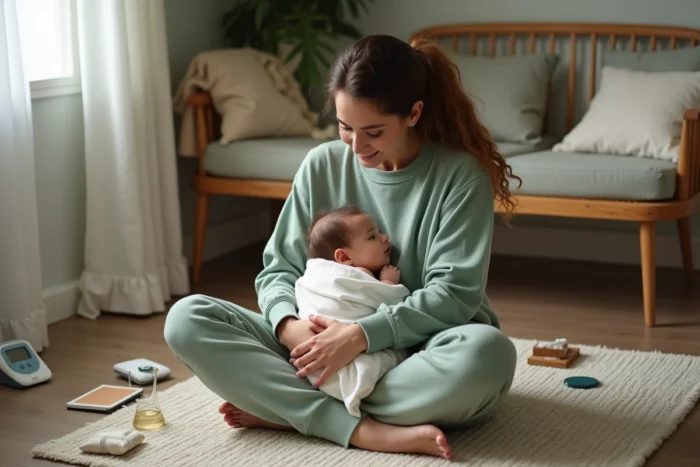
For breastfeeding, the issue of positioning is often underestimated. A nursing pillow or even a simple firm pillow under the arm supporting the baby prevents back and neck pain that can set in from the first week.
Alternating breastfeeding positions limits cracks and promotes complete emptying of the breast. Cradle hold, rugby hold, lying down: change from one feeding to the next rather than sticking to the same posture out of habit.
Home safety before baby’s first movements
We often think about securing the house when the child starts to crawl. The reality is that some preventive measures should be taken from birth.
- Check the proper functioning of the smoke detector, mandatory in France in every home
- Store household products and medications in closed cabinets, even if the baby is not yet mobile (an older child in the household or a visitor may leave them accessible)
- Secure tall furniture to the wall, especially dressers and shelves: tipping is a serious household accident, even with an infant placed on the floor on a play mat
- Secure electrical outlets with covers, and check that extension cords are not lying on the floor in high-traffic areas
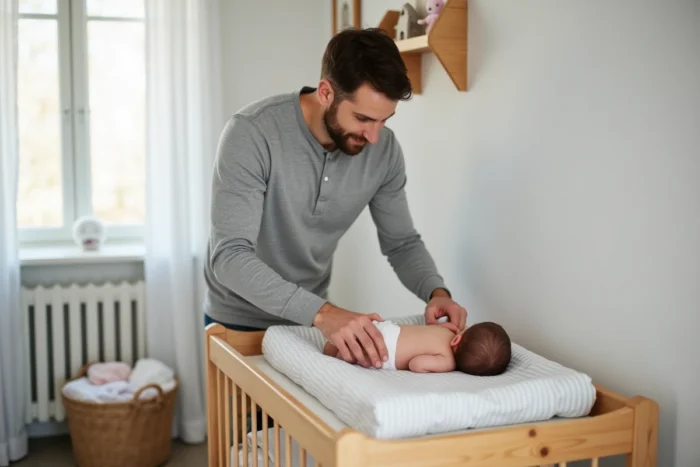
Household accidents also concern little ones who are not yet moving. A fall from a changing table is one of the leading causes of visits to pediatric emergency rooms. Always keep a hand on the baby during a change, even to grab a diaper thirty centimeters away.
Task distribution between parents: setting a framework from the first week
The fatigue of the first days blurs the references. You operate in survival mode, and imbalances in task distribution set in without you realizing it.
A functioning method that works for many couples: split the night into two fixed time slots. One parent handles the awakenings until two or three in the morning, the other takes over until morning. Each parent sleeps at least four hours straight, which radically changes the ability to cope with the next day.
The child welcoming leave, accessible to both parents, facilitates this organization. When both adults are present at home for several weeks, they can alternate roles (bathing, shopping, pediatric appointments) instead of relying solely on one parent.
The arrival of a baby reorganizes every detail of daily life, from the placement of a sleeping bag to the splitting of nights. The first months pass quickly, and the habits formed in the very first weeks set the tone for what follows. It’s better to get three things right than to chase after ten preparation lists that don’t match your own reality.