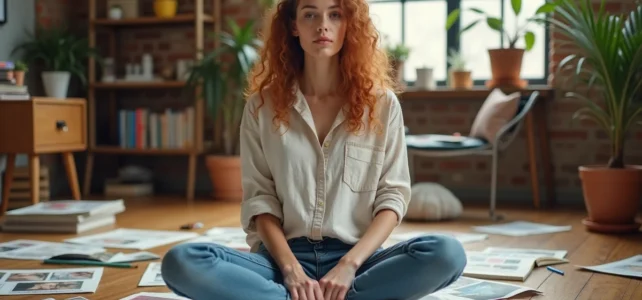
A Sunday afternoon without a plan, a child spinning in circles, eventually building a spaceship with three cushions and a dishcloth. This sequence is often observed when we leave a gap in the schedule. Stimulating imagination and curiosity daily doesn’t always require adding activities, but sometimes involves their intentional removal.
Empty time and creativity: what the absence of stimulation produces
We tend to fill every minute, especially those of children. Between screens, extracurricular activities, and structured games, true boredom is becoming rare. Psychoeducators and teachers note a gradual disappearance of boredom in children, directly linked to the omnipresence of screens and structured schedules.
Yet, boredom acts as a trigger. When the brain has nothing specific to process, it enters a mode that neuroscientists call mind-wandering. This free-thinking time enhances the ability to connect ideas and produce new connections, provided it is not filled with screen scrolling or repetitive tasks.
In practical terms, one can try a daily slot without screens or organized activities. Not a moment of imposed meditation, just emptiness. The creative proposals on ouvre-tete.fr stem from this logic: to provide a light starting point rather than a locked-in program, allowing imagination to take over.
Creative activities that provoke active thinking
Not all stimuli are equal. A child (or an adult) scrolling through short videos for an hour does not activate the same brain networks as one who listens to a documentary and asks questions out loud. Neuroscience clearly distinguishes passive consumption and active reflection in terms of lasting curiosity.
Formats that work better than others
Content that invites formulating a response or extending an idea nourishes creativity more sustainably than that which is absorbed effortlessly. We are talking about narrative podcasts, documentaries with open questions, and construction games without instructions.
- A family podcast followed by a simple question (“and you, what would you have done?”) is enough to transform passive listening into an exercise in imagination
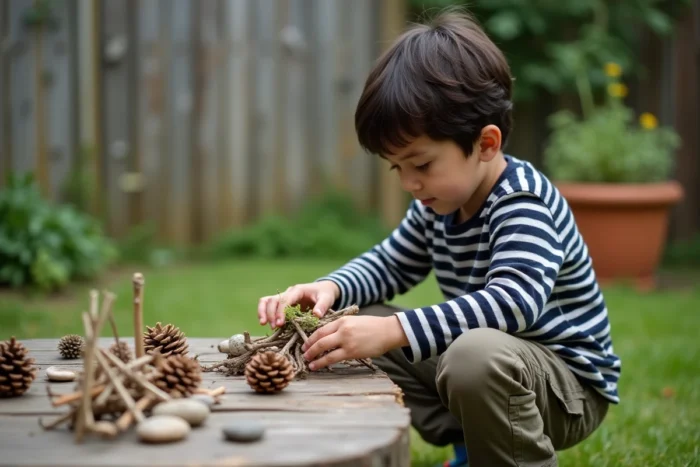
- Drawing or crafting from recycled materials, without a model to replicate, encourages inventing rather than copying
- Improvised role-playing games (not pre-written scenarios) require building responses in real-time, which strongly engages the imagination
The common point: we do not provide the answer. We provide a starting point, and the brain does the connection work on its own.
Daily curiosity: integrating micro-disruptions into the routine
Stimulating curiosity does not require reorganizing an entire day. Feedback varies on this point, but several simple approaches regularly emerge among field practitioners.
Change one parameter per day
Taking a different route to school. Eating a food never tasted before. Listening to music in an unknown language. These micro-disruptions of routine force the brain to step out of automatic mode and process new information.
It may seem trivial, but mental flexibility is developed through the accumulation of small deviations. Regular physical movement and varied social interactions also strengthen the brain networks related to adaptation and intellectual exploration.

Ask questions rather than give answers
In response to “why is the sky blue?”, a quick answer cuts the momentum. Responding with “what do you think?” or “how could we check?” transforms a closed question into a starting point for exploration. This reflex, simple to adopt, extends curiosity instead of closing it off.
We can also reverse the direction: ask ourselves questions we don’t have the answer to, in front of the child. Showing that an adult doesn’t know everything normalizes doubt, and doubt fuels inquiry.
Reducing stimulation to create better: practical guide
We’ve discussed empty time above. Here’s how to implement it without it turning into a family tug-of-war.
- Start with a short slot (about twenty minutes) rather than a whole half-day without screens, which will provoke resistance
- Do not offer an alternative. The goal is precisely to offer nothing. The child will find something, sometimes after a phase of restlessness
- Leave accessible materials (paper, crayons, cardboard, fabrics) without instructions. The presence of materials is enough to guide imagination without directing it
- Practice yourself. An adult reading, drawing, or daydreaming sends a stronger signal than an adult saying “go play”
Accessible materials without instructions guide imagination without directing it. This is the difference between a structured workshop and a free play area. Both have their place, but the latter develops creative autonomy.
Creativity does not need more content, more activities, or more programs. It needs space. A physical space with available materials, a temporal space without obligation, and a mental space freed from the constant flow of information. The most productive gesture to stimulate imagination sometimes remains to organize nothing at all.