
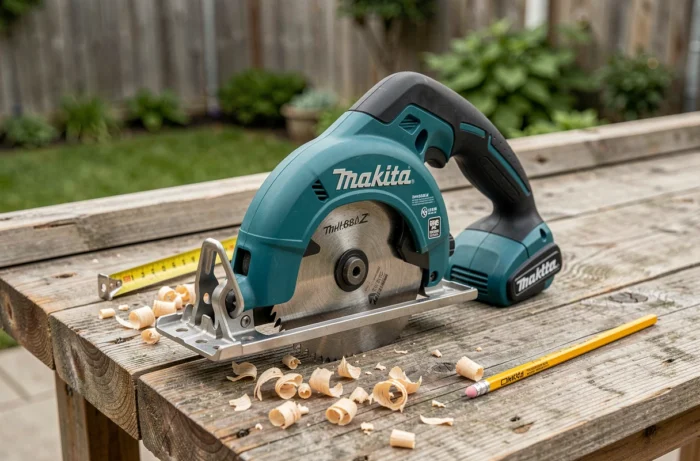
The Makita DHS680Z is an 18 V cordless circular saw equipped with a brushless motor (BL Motor) that runs up to 5,000 RPM. Its positioning does not aim for universal versatility: we recommend it for finish carpentry, door installation, panel cutting, and secondary work where precision takes precedence over raw cutting capacity.
Brushless motor and automatic speed control: what it changes in practice
The brushless motor of the DHS680Z significantly increases work capacity compared to a standard brushed motor. The removal of brushes reduces internal friction, resulting in less heat buildup and an extended mechanical lifespan.
The technical point that distinguishes this machine: the automatic speed control system. During a cut in dense material, the motor torque adjusts to maintain a stable speed. On soft coniferous wood, the saw does not unnecessarily rev up, which saves battery life. On a thick MDF panel, it compensates for resistance without the user needing to force the feed.
We observe that this type of electronic regulation, common in high-end corded saws, remains rare in cordless models in this price category. It’s a concrete advantage for those who perform multiple cuts on varied materials throughout the same day.
Cutting depth of the DHS680Z: real limits to know
The maximum depth reaches 57 mm at 90° and 41 mm at 45°. These values cover the majority of uses in interior carpentry: baseboards, door frames, parquet boards, plywood or particleboard panels up to 50 mm.
However, a piece measuring 2 × 6 inches (approximately 63 mm thick) cannot be cut in a single pass. If your work regularly involves framing or thick structural wood, this saw is not the right choice. It was designed for finish and implementation cuts, not for repetitive solid wood processing.
You will find a detailed sheet of the Makita DHS680Z on scie-circulaire.org that summarizes all the technical specifications and user feedback.
Guide rail adapter: transforming the DHS680Z into a rail saw
A use that consumer comparisons rarely mention: the DHS680Z accepts an optional guide rail adapter. This configuration functionally brings it closer to a plunge saw for panel cutting.
Practical tests show that guided cutting on a rail produces cleaner results than some plunge saws of comparable price. This observation is based on user feedback, not on standardized measurement, but it makes sense: the brushless motor maintains a constant speed, and the rail eliminates lateral deviations.
- On a laminate worktop, the rail eliminates surface chipping, provided a suitable fine-toothed blade is used
- For series panel cuts (furnishing, cabinets), the rail ensures repeatability that freehand cutting does not allow
- The cost of the adapter and rail remains lower than purchasing a dedicated plunge saw, making it a relevant solution for occasional use
Note: the machine’s light weight, which is an asset in maneuverability, requires more control from the operator during long freehand longitudinal cuts. On a rail, this issue disappears.

Makita 18 V LXT battery ecosystem: the real economic calculation
The DHS680Z is sold as a “tool only,” without battery or charger. This format is only cost-effective if you already own the LXT 18 V ecosystem. Makita offers over a hundred tools compatible with this platform: drill drivers, hammer drills, grinders, string trimmers. Each LXT battery powers any of these tools.
For a new user, the actual budget must include the price of at least one battery and a charger. This additional expense significantly changes the value-for-money ratio compared to a comparable corded circular saw.
- Users already equipped with LXT 18 V: the DHS680Z represents a moderate investment to add a compact circular saw to their collection
- New users without Makita batteries: compare the total cost (tool + battery + charger) with complete competing kits
- Multi-brand users: avoid third-party battery adapters, which pose risks to the tool’s and battery’s electronic protection
Safety and ergonomics on site
The DHS680Z features a lock button that prevents accidental trigger activation during transport. This device may seem trivial, but on a job site where the tool is passed from hand to hand or travels in a bag, it prevents unintentional starts.
The machine’s lightweight design facilitates cuts at height or in uncomfortable positions (under slopes, ceilings). The downside: during a long straight cut in medium-density wood, the lack of mass requires the operator to maintain consistent pressure on the base.
The blade brake engages as soon as the trigger is released. The blade comes to a complete stop within seconds, which limits risk during rapid succession of multiple cuts.
The DHS680Z is not a universal saw. It excels within a specific perimeter: finish cuts, panels, interior carpentry, mobile work. Users already integrated into the Makita LXT 18 V ecosystem will find a reliable and maneuverable tool, provided they do not ask it to perform tasks for which it was not designed.