
The eye of Saint Lucia is a calcareous operculum, not a stone. This distinction conditions every step of the cleaning process: the pearly face with its characteristic spiral is softer than quartz or agate, and it reacts poorly to acids, coarse abrasives, and prolonged soaking. Cleaning this operculum before setting it into jewelry requires an approach suited to its composition, not a generic protocol copied from cleaning pearls or crystals.
Sensitivity of limestone and risks of scratching on the eye of Saint Lucia
Most guides start the cleaning process with soapy water. This skips a step. An operculum picked up on the beach or bought raw carries grains of sand, micro-shells, and salt residues embedded in the reliefs of the spiral.
Rubbing directly with a damp cloth means pressing these abrasive particles against the nacre and creating micro-scratches that will be visible once polishing is complete. The calcium carbonate that makes up the operculum ranks quite low on the hardness scale, making it vulnerable to any particle harder than itself, including an ordinary grain of sand.
The first action is to remove particles dry before any contact with water. A soft brush (like a clean makeup brush or natural bristle brush) can dislodge grains trapped in the spiral without pressing on the surface. Turning the operculum pearly side down during this brushing avoids redepositing debris on the most fragile area.
This preliminary dusting, often absent from tutorials, significantly reduces the risk of scratching during the subsequent steps. If you are looking for tips for jewelry with an eye of Saint Lucia, this initial precaution is part of the actions that preserve the final shine of the piece.
Comparative cleaning methods: warm water, vinegar, ultrasound
Three methods are regularly circulated for cleaning an eye of Saint Lucia. Their effects on the calcareous operculum are not equivalent.
| Method | Principle | Effect on the calcareous operculum | Suitable for pre-jewelry cleaning |
|---|---|---|---|
| Warm water + mild soap (like dish soap) | Dissolution of organic residues and salt | No alteration if soaking is brief | Yes |
| Diluted white vinegar | Acetic acid that dissolves limestone deposits | Attacks the surface of the operculum itself | No |
| Ultrasonic cleaner | Micro-vibrations in a liquid bath | Risk of cracking on thin or already set opercula | No |
Vinegar, even when highly diluted, remains an acid. The operculum itself being made of limestone, it undergoes the same reaction as the deposits one seeks to remove: a gradual dissolution that dulls the spiral and weakens the edges.
Ultrasonic devices pose a different problem. An isolated, thick, and uncracked operculum could theoretically tolerate them. However, as soon as the eye is combined with glue, a setting, or a wire, the vibrations weaken the assembly. A Corsican manufacturer of jewelry featuring the eye of Saint Lucia even recommends avoiding these devices as well as chemical cleaners for silver jewelry, which clean the shell.
Warm water and mild soap protocol
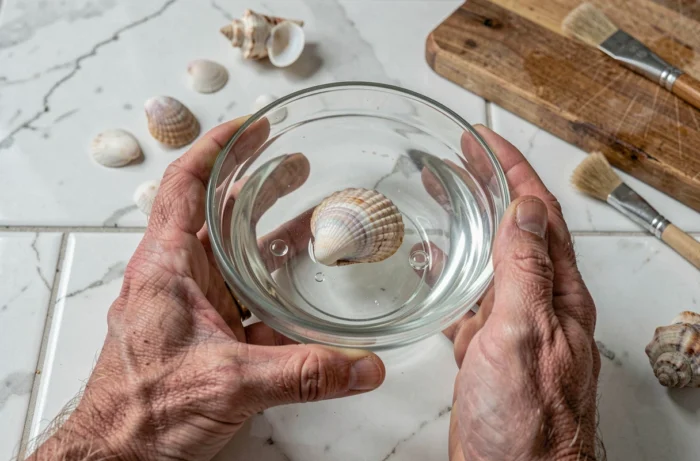
After the dry dusting, prepare a bowl of warm water (not hot) with a few drops of neutral dish soap. Soak the operculum for a few minutes, no longer. A prolonged soak causes the micro-porosities of the limestone to swell and can lead to uneven whitening of the pearly face.
Then use a soft toothbrush to gently clean the flat side (the underside) and the edges, where dried algae often accumulate. On the pearly face, prefer a damp microfiber cloth, using light circular movements that follow the spiral.
Rinse with clear water, then dry immediately with a soft cloth. Do not let it air dry: traces of calcareous water will settle and create a dull veil that is difficult to remove without polishing.

Adapting cleaning when the operculum is already mounted on a support
Cleaning a raw eye of Saint Lucia and cleaning an eye already set in a pendant or glued onto a support are two distinct operations. Online content almost always addresses the isolated operculum, without discussing the common case of an assembled piece of jewelry that needs maintenance before retouching or remounting.
The rule is simple: adapt the method to the most sensitive component of the assembly. If the eye is fixed with glue (cyanoacrylate, epoxy resin), even a short soak can soften the joint. If the jewelry has a leather cord or elastic thread, water degrades these materials long before affecting the shell.
- Eye glued in a setting: clean only with a slightly damp microfiber cloth, without soaking. Focus on the contours of the setting with a barely moistened cotton swab.
- Eye mounted on wire or cord: remove the operculum from the mounting if possible, clean it separately, then remount it once dry.
- Eye combined with silver findings: avoid any silver cleaning product (soaks, creams) that attacks the calcareous surface. A chamois cloth is sufficient for the metal parts, applied without touching the operculum.
This component-based reasoning avoids unpleasant surprises. A five-minute soak that seems harmless for a solo operculum can detach a set eye and ruin several hours of work.
Light polishing after cleaning: when and how to polish the nacre
Cleaning removes impurities, not micro-scratches. If the operculum appears dull after drying, gentle polishing can restore its shine before setting it into jewelry.
A piece of felt or a chamois cloth, used dry, is sufficient for most opercula. Rub with regular circular motions for a few minutes. The friction generates a slight heat that smooths the calcareous surface without abrading it.
For more dull or slightly scratched opercula, very fine sandpaper (high grit) can be used on the flat side, never on the spiraled nacre side. Each pass of grit removes a micro-layer of material, which is irreversible. It is better to proceed with very gradual steps than to seek an immediate result.
A properly cleaned and lightly polished operculum retains a natural shine that improves with contact with the skin once worn. Natural sebum acts as a discreet polishing agent, which explains why regularly worn jewelry remains shinier than those stored in a box.