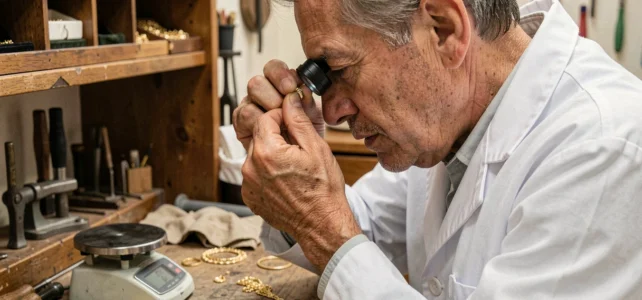
You have an old bracelet or a 9-carat gold ring in a drawer. Before visiting a professional, understanding how its value is calculated can help avoid unpleasant surprises. The price of 9-carat gold depends on a few simple data points, but the way they interact changes everything about the final amount.
Gold content of 9 carats: the figure that determines the entire calculation
9-carat gold contains 37.5% pure gold. The rest, nearly two-thirds of the weight, is made up of an alloy (copper, silver, zinc depending on the color). This proportion is also expressed in thousandths: we refer to it as 375 thousandths gold.
Why does this detail matter so much? Because the gold price displayed in the press or on specialized websites corresponds to pure gold, which is 24 carats. Therefore, one gram of 9-carat jewelry contains only 0.375 grams of fine gold. All calculations start from there.
To better understand the calculation of the price of 9-carat gold, you should always think in terms of grams of fine gold, not grams of raw jewelry. This is the most common confusion among individuals who discover a discrepancy between the weighed weight and the proposed price.
Formula for calculating the price of 9-carat gold per gram
The formula can be summarized in one line. Take the price of fine gold per gram for the day, then multiply it by 0.375. You get the theoretical value of the pure gold component in one gram of 9 carats.
At the end of 2024, the price of fine gold was around 83 euros per gram (December fixing). Therefore, one gram of 9 carats contained about 31 euros of pure gold. This amount is a theoretical ceiling, not a real buyback price.
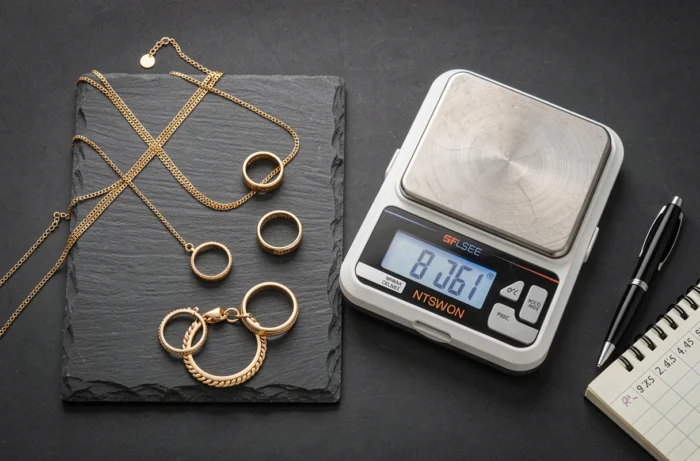
Here are the concrete steps to estimate the value of a piece of jewelry:
- Weigh the jewelry on a precision scale (to the tenth of a gram if possible), removing any non-metallic elements (stones, steel clasps).
- Identify the hallmark: a three-leaf clover indicates 9 carats in France. Without a hallmark, the professional will conduct an acid test or X-ray test.
- Multiply the net weight by 0.375, then by the price of fine gold per gram for the day. This result is the theoretical gold value of your jewelry.
This calculation does not take into account the professional’s margin, refining fees, or taxes. It provides a reference point, not a guaranteed selling price.
Discount on buyback: why the proposed price is always lower than the market price
No counter buys at the spot price. Professionals apply a discount that can range from 15% to 40% of the theoretical price. This range varies depending on the quantity brought in, the condition of the jewelry, and the counter’s commercial policy.
9 carats often suffers a greater discount than 18 carats. The reason is technical: refining an alloy containing only 37.5% gold is proportionally more expensive than refining an alloy with 75%. The professional incorporates this extra cost into their offer.
In practical terms, if the theoretical value of a 9-carat bracelet is 90 euros, the price offered at the counter may be significantly lower. Comparing multiple offers remains the only way to get closer to the best buyback rate.
Factors that cause variations in discounts from one counter to another
- The volume brought in: a batch of jewelry weighing several tens of grams generally receives a better rate than a single item weighing a few grams.
- The transparency of the professional: some display their buyback rate as a percentage of the spot price, others do not. Always ask for this percentage before concluding.
- The location: counters in city centers of large urban areas have higher overhead costs, which can affect the proposed price.
- The day’s price: a sharply rising gold price prompts counters to adjust their rates, sometimes with a slight delay.

Taxation on the sale of 9-carat gold in France
Selling a piece of gold jewelry triggers taxation as soon as the transaction amount exceeds a certain threshold. Two regimes coexist in France for precious metals.
The first is the flat tax on precious metals, levied on the total selling price. The second is the regime for actual capital gains, applicable if you can prove the date and price of acquisition of the jewelry. This second regime includes a progressive allowance for each year of ownership.
For a 9-carat piece inherited or purchased a long time ago without a receipt, the flat regime applies by default. The choice between the two regimes can significantly affect the net amount received, especially if the capital gain is low or if the holding period is long.
Gold price in 2024: what the increase changes for 9 carats
The year 2024 saw a marked increase in the price of gold. In November, the average price was around 2,650 euros per ounce, or about 85 euros per gram of fine gold. A month later, the fixing stabilized around 2,582 euros per ounce.
This increase mechanically amplifies the value of 9-carat jewelry, even if their gold content remains low. A bracelet that was worth a few dozen euros in gold content a few years ago can today reach an amount that justifies the decision to sell.
Buyback professionals have also noticed an influx of individuals bringing out their old jewelry. The rise in price makes 9 carats more interesting to sell than it has been for a long time.
Before you go, check the day’s price on a reference site displaying real-time fixing. Calculate the theoretical value of your jewelry yourself using the formula described above. This numerical reference transforms the negotiation at the counter: you know what your gold contains and what it is worth before any discount.