Vegetables starting with the letter S pose a recurring problem for players of the game “petit bac” and quiz enthusiasts. The category seems simple, but the actual list is short, and confusions with herbs or fruits artificially inflate most of the inventories available online.
Vegetables starting with S and aromatic plants: a blurred boundary in existing lists
The main difficulty with vegetables starting with S lies less in their number than in the very definition of what is accepted as a “vegetable.” Competing lists regularly mix distinct botanical categories, which skews preparation for word games.
On the alphabetical list of the site Les Fruits et Légumes Frais, the letter S clearly refers only to salad on the vegetable side and sapodilla on the fruit side. This is a reliable basis, but it surprises with its conciseness. Other sources add samphire, savory, or thyme, which fall under aromatic plants or condiments, not vegetables in the strict sense of “petit bac.”
Soybeans present a particular case. A legume by its botanical classification, it appears in some game grids as an accepted vegetable starting with S. It all depends on the level of rigor of the referee or the rules adopted by the group. It is therefore useful to consult L’Art du Goût online to verify which entries are retained according to the contexts.
Salsify, scorzonera, salad: the true vegetables starting with S to remember for petit bac
Rather than piling up dozens of uncertain names, it is better to master the few vegetables starting with S that pass without contestation in the majority of word games.
Salad and its variants
Salad is the first word that comes to mind, and it is the most solid. Quiz and “petit bac” engines also value variants from the same family: green salad, iceberg lettuce, frisée lettuce, batavia lettuce. These variations do not correspond to truly distinct vegetables, but they are regularly accepted in “petit bac” when the rule allows qualifying adjectives.
In Scrabble, only the word “salad” without a qualifier is playable. The distinction between free word games (petit bac) and regulated board games (Scrabble) thus changes the response strategy.
Salsify and scorzonera
Salsify frequently appears in general knowledge answers related to vegetables starting with S. It is a root vegetable, once common in French gardens, whose presence in public lists remains irregular. The scorzonera, sometimes called black salsify, is even rarer in inventories, even though it constitutes a full-fledged vegetable.
For games, remembering the pair salsify/scorzonera covers an angle that most opponents ignore. Scorzonera almost always surprises and earns easy points in “petit bac” when root vegetable names are accepted.
Soy: accepted under conditions
As mentioned earlier, soybeans fall under legumes. In a general knowledge quiz, they often pass. In a strict “petit bac,” field feedback varies on this point. A useful rule: check before the game if legumes count as vegetables.
Common traps in quizzes about vegetables starting with S
Several names come up in players’ answers even though they do not correspond to vegetables. Knowing them helps avoid losing points on contestation.
- Savory and thyme are aromatic herbs, not vegetables. Their presence in some online lists creates persistent confusion.
- The sapodilla is a tropical fruit, often mistakenly cited in the vegetable category because it appears under the letter S in mixed fruit/vegetable lists.
- Samphire, consumed as a vegetable in some coastal regions, technically falls under halophytic plants. Its acceptance varies according to sources and game rules.
This list of traps highlights a structural problem: online inventories aggregate everything that starts with S without distinguishing categories. An informed player filters these results before memorizing them.
Memorization strategy for letter games with the letter S
Rather than memorizing a long list of uncertain names, a tiered approach works better for quizzes and “petit bac.”
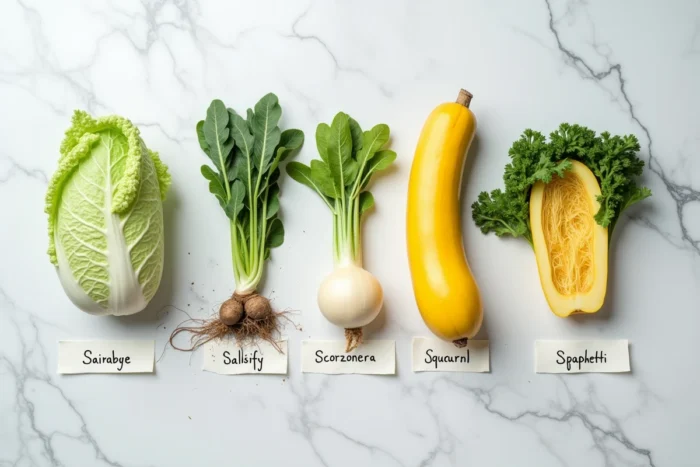
The first tier groups the sure answers, those that provoke no contestation: salad and salsify. These two words are sufficient in the majority of games.
The second tier adds solid but less known answers: scorzonera and, depending on the rules, soy. Mastering these four names covers almost all game situations.
The third tier, riskier, includes debatable cases like samphire. These answers are only worth it if the group of players adopts a broad definition of the word “vegetable.”
- Tier 1 (always accepted): salad, salsify
- Tier 2 (accepted in most contexts): scorzonera, soy
- Tier 3 (variable according to rules): samphire
This hierarchy avoids memorizing dozens of names only to use two or three in real situations. The effort/result ratio clearly favors mastering the first and second tiers.
The letter S remains one of the trickiest in “petit bac” in the vegetable category, precisely because the number of true vegetables starting with S is very limited. It is better to accept this rarity and prepare reliable answers than to rely on lists inflated by misclassified herbs and fruits.