
Sin and cosine present a recurring problem: most students manipulate these functions without visualizing what they measure. Abstract definitions (ratios of sides in a right triangle, coordinates on the unit circle) coexist in textbooks, but the transition from one to the other remains unclear. This article compares these two approaches to sin and cos, identifies points of friction, and details concrete methods to connect trigonometric formulas and geometric intuition.
Right Triangle or Unit Circle: Two Definitions of Sin and Cos Face to Face
The most common confusion in trigonometry arises from the fact that sin and cos receive two distinct definitions depending on the context. The table below contrasts their characteristics to clarify what changes from one approach to the other.
| Criterion | Definition by Right Triangle | Definition by Unit Circle |
|---|---|---|
| Domain of Angles | Acute angles only (between 0 and 90 degrees) | Any real angle, including negative |
| sin(x) | Ratio of opposite side / hypotenuse | Y-coordinate of the point on the unit circle |
| cos(x) | Ratio of adjacent side / hypotenuse | X-coordinate of the point on the unit circle |
| Possible Values | Always positive (acute angle) | Between -1 and 1, positive or negative |
| Visible Periodicity | No | Yes (returns to the same point after a full turn) |
| Main Use | Calculating lengths, solving triangles | Studying functions, modeling periodic phenomena |
The definition by the right triangle is suitable for classic plane geometry problems. In contrast, as soon as an angle exceeds 90 degrees or becomes negative, only the definition by the unit circle works. The unit circle generalizes the right triangle; it does not contradict it.
Mastering the trigonometric formulas for sin and cos first requires knowing in which framework one is operating, as sign errors almost always stem from an unintentional mixing of these two definitions.

Addition Formulas for Sin and Cos: How to Read Them Without Enduring Them
The addition formulas are the hard core of analytical trigonometry. Their appearance is daunting, but their internal logic is consistent.
Common Structure of Addition Formulas
Here are the four basic addition formulas:
- cos(a + b) = cos(a)cos(b) – sin(a)sin(b), often summarized by the mnemonic “coco minus sisi”
- cos(a – b) = cos(a)cos(b) + sin(a)sin(b), same structure but the sign reverses
- sin(a + b) = sin(a)cos(b) + cos(a)sin(b), summarized by “sico plus cosi”
- sin(a – b) = sin(a)cos(b) – cos(a)sin(b), the sign changes again
Cosine mixes identical functions (cos with cos, sin with sin). Sine, on the other hand, crosses functions (sin with cos, cos with sin). This regularity is not a coincidence: it directly stems from the geometry of the unit circle and the parity properties of each function.
Why the Sign Changes Depending on the Operation
Cosine is an even function: cos(-x) = cos(x). Sine is an odd function: sin(-x) = -sin(x). When transitioning from a + b to a – b, b is replaced by -b. The cosine of b does not change, but the sine of b changes sign. That’s why only the central sign of the formula reverses.
Reading the formulas with this framework (parity of sine, parity of cosine) prevents them from being learned as four independent blocks. One retains the version with the “+”, then deduces the version with the “-” by applying the sign rule.
Remarkable Angles in Trigonometry: Values to Know and Their Logic
The remarkable angles (0, 30, 45, 60, and 90 degrees) appear in almost all exercises and assessments. Their sin and cos values follow a pattern that can be reconstructed instead of memorizing line by line.
| Angle (degrees) | Angle (radians) | sin | cos |
|---|---|---|---|
| 0 | 0 | 0 | 1 |
| 30 | pi/6 | 1/2 | sqrt(3)/2 |
| 45 | pi/4 | sqrt(2)/2 | sqrt(2)/2 |
| 60 | pi/3 | sqrt(3)/2 | 1/2 |
| 90 | pi/2 | 1 | 0 |
The sin column reads from top to bottom: 0, 1/2, sqrt(2)/2, sqrt(3)/2, 1. The cos column reads in reverse order. This mirror between sin and cos reflects the relationship cos(x) = sin(pi/2 – x), in other words, the complementarity of the two functions in a right triangle.
At 45 degrees, sin and cos are equal. It is the only acute angle where the two values coincide, which geometrically corresponds to the isosceles right triangle.
Interactive Visualization of Sin and Cos: What Recent Research Shows
Memorizing trigonometric formulas produces fragile results. A study published in the European Journal of Mathematics, Science and Technology Education in 2026 shows that the understanding of sin and cos remains very fragile even among future mathematics teachers, particularly regarding phase shifts and curve transformations.
In contrast, research published in 2026 by Hans Publishers indicates that using dynamic image generators (incorporating artificial intelligence) to visualize functions of the type y = A sin(omega x + phi) significantly enhances students’ intuition about the effect of each parameter (amplitude, frequency, phase).
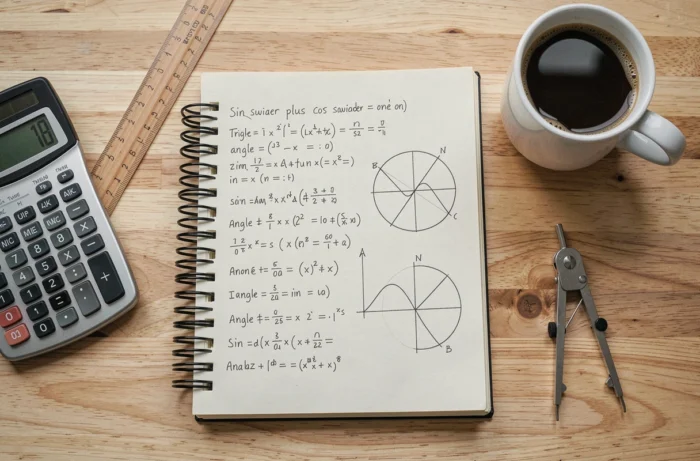
Platforms like GeoGebra allow real-time adjustments of a sinusoidal curve’s parameters. Manipulating a slider to see the curve deform replaces dozens of abstract exercises. The shift from formula-based learning to visual experimentation is now recommended in several educational contexts, including high school curricula.
Understanding sin and cos relies less on the quantity of memorized formulas than on the ability to connect each expression to a concrete geometric transformation. The two tables in this article (definitions, remarkable angles) form a foundation. The addition formulas can be deduced from parity. And dynamic visualization, now freely accessible, bridges the gap between algebraic notation and spatial intuition that formulas alone do not convey.