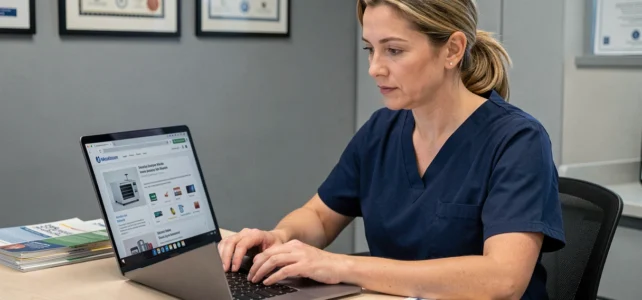
The European regulatory tightening around medical devices is redefining the criteria for selecting an online supplier. Purchasing professional medical equipment online is no longer just about comparing prices: documentary compliance, traceability of references, and the technical qualification of the seller now condition the very validity of the equipment in a practice or healthcare facility.
EUDAMED Verification and Traceability of Medical Devices Online
Since May 28, 2026, four modules of the European EUDAMED database have become mandatory for stakeholders in the medical device sector. This shift fundamentally changes the way we evaluate an online supplier.
Before placing any order, it is essential to verify that each product reference has a unique device identifier (IUD/UDI) registered in EUDAMED. A seller who is unable to provide this number or point to the corresponding EUDAMED record poses a direct regulatory risk for the professional buyer.
The traceability obligation does not only concern the manufacturer. It extends to distributors and platforms that make these devices available. We recommend systematically cross-checking three elements before validating a cart: the CE marking of the product, the presence of the IUD on the packaging or product sheet, and consistency with publicly accessible EUDAMED data. This verification takes a few minutes and prevents non-compliance during an ARS inspection or HAS certification.
To structure this approach, the purchase of professional medical equipment on Orvinfait allows for centralizing orders with suppliers whose references are already qualified from a regulatory standpoint.

Electronic Instructions and Medical Software: Two Blind Spots in Online Purchasing
The implementing regulation (EU) 2025/1234, which came into force on July 16, 2025, has expanded the possibility of providing instructions for use in electronic format for nearly all medical devices for professional use. In practice, this means that an online supplier may legitimately no longer include a paper manual with the delivery.
This point deserves attention. Upon receipt, check that the seller provides functional access to the e-IFU (electronic Instructions For Use), either via a QR code on the packaging or through a dedicated link in the customer area. The complete absence of a manual, whether paper or electronic, remains a non-compliance.
Medical Device Software on Marketplaces
The MDCG 2025-4 guidance, published by the European Commission in June 2025, specifically regulates the secure provision of medical device software on online platforms and stores. This text introduces new obligations for marketplaces selling qualified medical device software.
Medical diagnostic software sold online must display its MDR classification and its declaration of conformity directly on the product page. Generalist platforms do not always comply with this requirement. We observe that specialized medical equipment sites more systematically integrate these regulatory data into their product sheets.
Technical Criteria for Qualifying an Online Medical Equipment Supplier
Comparing suppliers cannot be limited to catalog prices and delivery times. Several technical criteria distinguish reliable sellers from high-risk resellers.
- Accessible technical documentation: each product sheet must mention the device class (I, IIa, IIb, III), the manufacturer’s name, the country of manufacture, and the notified body number if applicable.
- Qualified after-sales service: for diagnostic or monitoring equipment, the supplier must offer preventive and corrective maintenance provided by technicians trained by the manufacturer.
- Management of lot recalls: a serious supplier has an alert system that notifies its clients in case of a recall or market withdrawal via EUDAMED.
- Compatibility with business software: connected equipment must be able to interface with the management software of the practice or facility, which implies documented interoperability specifications.

Financing and Renting Medical Equipment: Deciding Between Purchase and Leasing
The choice between outright purchase and leasing depends on the lifecycle of the equipment. For equipment with rapid obsolescence (portable ultrasound machines, connected monitors), renting or leasing allows for renewing the inventory without tying up cash flow. For medical furniture or technologically stable instrumentation, purchasing remains more cost-effective over time.
Several online suppliers now offer financing options integrated into the purchasing process. Before subscribing, we recommend checking three points:
- The total cost of financing relative to the expected usage duration of the equipment.
- The conditions for buyback or upgrades at the end of the contract, especially for digital devices subject to regulatory updates.
- The maintenance coverage included or not in the rental contract, which can represent a significant cost for diagnostic equipment.
Used Medical Equipment: Specific Precautions
Purchasing used equipment online requires heightened vigilance. A resold medical device must retain its CE marking and complete technical documentation. The seller must provide the maintenance history and confirm that the device has not been subject to any safety recalls.
For used digital devices, the issue of software licenses and security updates arises systematically. A device for which the manufacturer has ceased software support loses its regulatory compliance, even if the equipment still functions physically.
Digital Medical Devices Integrating AI: An Emerging Purchase Criterion
Since September 2025, criterion 3.4-05 of the HAS certification framework requires healthcare facilities to supervise the use of digital medical devices incorporating artificial intelligence. This requirement has a direct impact on the choice of an online supplier.
When purchasing a device incorporating AI (radiological diagnostic assistance, automated dermatological analysis, predictive monitoring), the supplier must be able to document the functional scope of the algorithm, its validated usage limits, and the model update procedures. A supplier who does not specify the version of the embedded algorithm does not meet HAS requirements.
This criterion remains poorly verified on generalist marketplaces. Hospital and independent buyers are better off prioritizing specialized platforms that structure this information in their product sheets, rather than marketplaces where technical documentation remains partial.