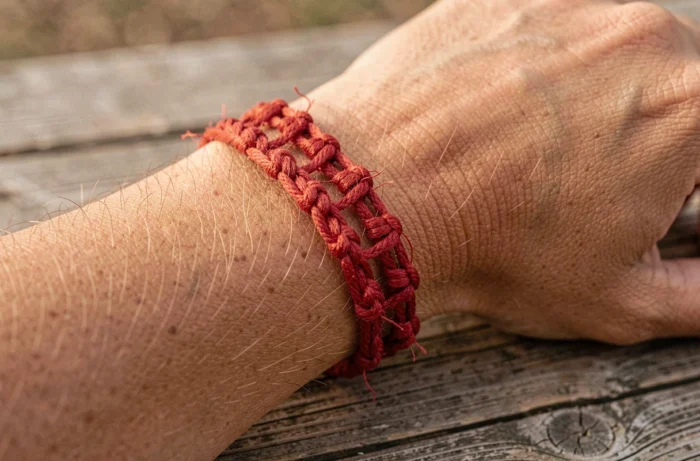
The seven-knot red bracelet goes by various names (Tibetan bracelet, Kabbalah bracelet, protective red string), but the question that determines its symbolic significance is rarely asked: was the cord blessed in a ritual, or did it come from a mass-production workshop without any blessing? The answer radically changes what the object represents.
Blessed cord or decorative bracelet: what distinguishes a sungdü from a commercial red string
In Tibetan Buddhism, a protective cord is called a sungdü. A lama ties it while reciting mantras, and according to tradition, this consecration process gives it its protective function. The number of knots varies: one, three, five, nine, or more, depending on the lineage and the ritual performed.
Seven is not a universal prescription. We find that it has become an online retail standard, probably because it evokes broadly familiar symbolism (the seven chakras, the seven days of the week) that is easy to understand outside a religious context. Nothing in Tibetan sources identifies it as the only valid number.
A bracelet sold as a “seven-knot Tibetan bracelet” on a marketplace, with no mention of a monastery or a lama who performed the consecration, is a textile object. It may have aesthetic or sentimental value, but attributing the same properties to it as to a consecrated sungdü means confusing a shop souvenir with a ritual object. To learn more about the meaning of wearing a red bracelet on the right wrist, this distinction between consecration and decoration remains the starting point.

Protective red bracelet: three traditions, three distinct meanings
Grouping practices from different traditions under the term “protective red bracelet” creates a common source of confusion. Here is what each one actually refers to:
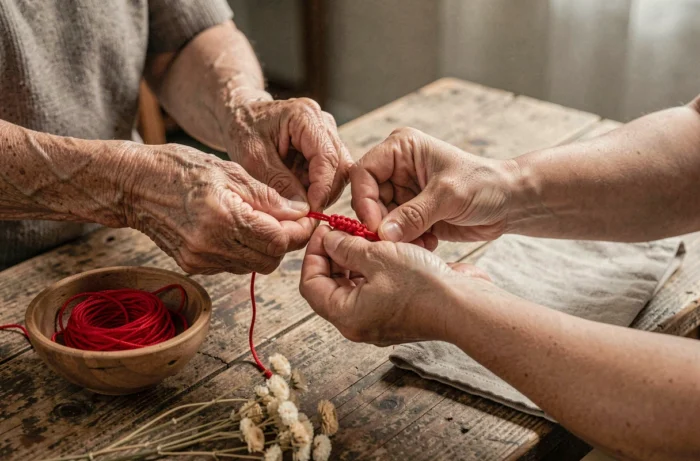
- The Kabbalah red string is associated with protection from the evil eye. According to this tradition, the cord is wrapped around the left wrist, considered the receptive side of the body. The ritual often involves a loved one tying the bracelet while offering blessings.
- The Chinese red thread of fate (hongxian) has no protective function. It symbolizes the bond between two people destined to meet, tied according to legend by the lunar deity Yue Lao. Its red color represents good fortune and marriage, not a barrier against negative energies.
- The Tibetan sungdü serves as a vehicle for a blessing associated with a mantra. Its color may vary (red, yellow, multicolored) depending on the deity invoked during the consecration. Its attributed protective power comes from the ritual, not the color of the thread.
Combining these three traditions under a single label, “protective red bracelet,” erases their cultural context. Someone who thinks they are buying a Kabbalah object but is wearing an unconsecrated Tibetan cord ends up with something that fits none of these practices.
Protective powers of the red bracelet: spiritual belief or measurable effect
No clinical study has shown that a red string protects against physical danger or cures illness. Research sometimes cited in commercial guides concerns copper bracelets or magnetic straps, not textile cords. There is no scientific basis for attributing medical powers to a red string.
The bracelet’s value operates on another level. Several traditions describe it as a personal reminder, a visual anchor that brings attention back to an intention set when the cord was tied. This mechanism is similar to a mindfulness aid: the wearer touches or looks at the bracelet and recenters themselves.
This distinction matters. A red bracelet can serve as a signal to pause in everyday life, an object that marks a commitment to oneself, without needing to be credited with a supernatural effect. People who wear a consecrated sungdü see it as the trace of a blessing they received, which is a matter of faith. People who wear a red string bought online may find it a way to focus their intentions, which is a personal ritual.
What the bracelet does not do
It does not replace medical treatment. It does not protect against accidents. It does not guarantee good luck. Presenting these effects as real, even implicitly, is a commercial tactic that exploits credulity rather than spirituality.
Seven-knot red bracelet: how to tell a ritual object from a marketing product
Before assigning meaning to a seven-knot red bracelet, a few criteria can help you assess what you are actually wearing:
- The origin is traceable: the seller names a monastery, a lama, or a verifiable consecration context.
- The number of knots corresponds to an identified tradition, rather than a round number chosen for the packaging.
- The material and color vary depending on the practice: a sungdü may be multicolored, while a Kabbalah string is typically made of red wool. A standardized, bright-red synthetic cord is not associated with any specific tradition.
- The seller does not promise healing, protection from accidents, or guaranteed good luck. Any such claim is a warning sign.
The seven-knot red bracelet remains part of many people’s practices, whether they see it as a spiritual object or simply a daily reminder. What changes its significance is the context in which it was made and tied. A thread consecrated in an authentic ritual carries the trace of a tradition. A thread bought without context carries the trace of a transaction.